

Ten partners coordinated by Fraunhofer IAP have launched SafeDrop, a Horizon Europe project to detect contaminants on site in minutes rather than days.

A European research consortium has launched SafeDrop, a four-year project to build a sensor that works like a dog’s nose. The goal is laboratory-grade detection of contaminants and pathogens on site, in minutes rather than days. Coordinated by the Fraunhofer Institute for Applied Polymer Research IAP in Potsdam-Golm, Germany, the project started on 1 June 2026 with nearly €6 million in Horizon Europe funding.
Ten partners from seven European countries are taking part. Checking a water supply for heavy metals, or confirming a urinary tract infection, usually means sending a sample to a central laboratory. Lab results are accurate, but slow and costly. Portable sensors are fast, but often not selective enough to trust for critical decisions. SafeDrop aims to offer both speed and confidence in one compact device.
Learning from the dog’s nose
A dog does not have one perfect receptor for each smell. It reads patterns across many overlapping receptors, and its brain recognises the combination. SafeDrop copies this principle on a chip. Its array of 32 sensing units, called K-cells, each pairs a silicon-photonic interferometer with a thin-film transistor. Every K-cell carries a slightly different organic-semiconductor coating, so each reacts to a sample in its own way.
The chip reads an optical and an electrical signal from the same interaction at once, giving 64 channels in total. Artificial intelligence then decodes the resulting chemical fingerprint. The project is targeting detection of heavy metals such as lead below one part per billion, pathogens below 100 colony-forming units per millilitre, and a result in under 30 minutes. A reusable reader works with a disposable cartridge targeted at €10 or less, falling to €5 at scale.
Four demonstrators
SafeDrop will validate the platform in four application areas:
- Water quality: heavy metals and pathogens in water, with results in under 30 minutes.
- Health: point-of-care diagnosis of urinary tract infections.
- Food safety: an apple-juice demonstrator benchmarked against laboratory LC-MS/MS analysis.
- Air quality: detection of volatile organic compounds, progressing to a drone-mounted sensor.
The consortium
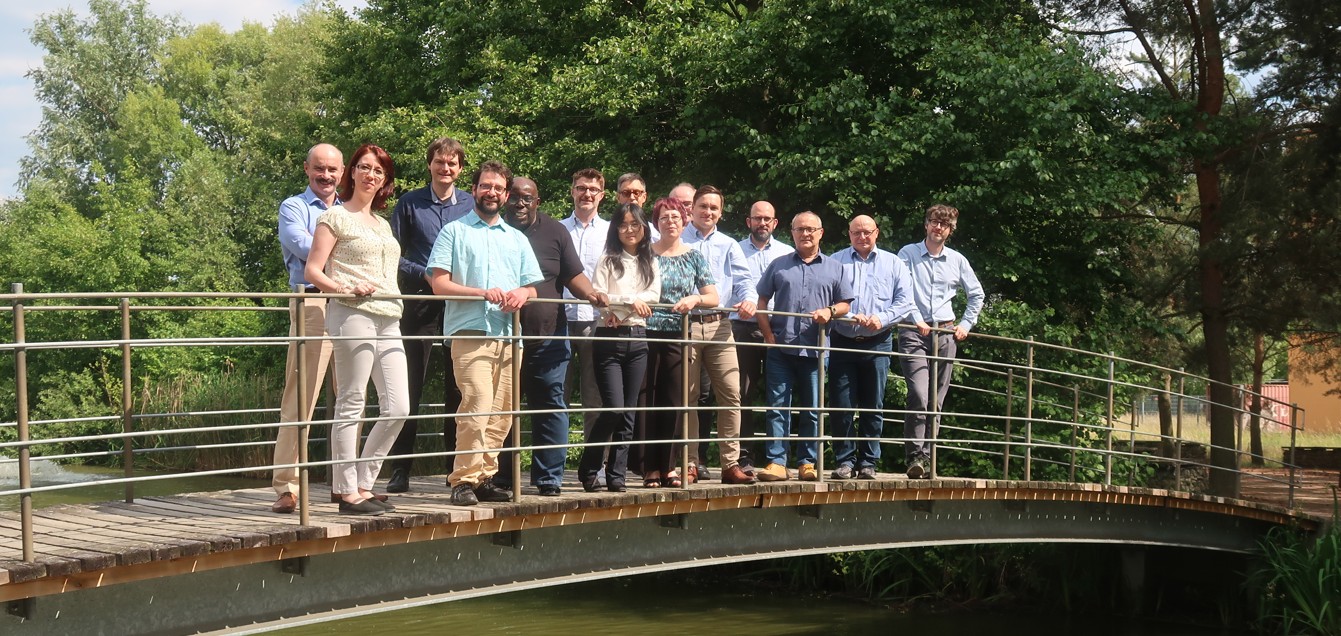
The ten partners met for the project kick-off at Fraunhofer IAP on 18–19 June 2026 to agree the work plan. Together they cover materials chemistry, silicon photonics, packaging, microfluidics, electronics, AI and field testing.
“Laboratory analysis gives us confidence, but samples can wait days for an answer. With SafeDrop, we want to bring that confidence to the point of need, so that decisions about water, food and health can be made on the spot,” said Manuel Gensler, Fraunhofer IAP, SafeDrop project coordinator.
“SafeDrop is being built in the open. During the project we will release a Photonic Design Kit, open-source software and FAIR datasets, so European companies and researchers can build their own sensors on the platform,” said Per Kjellgren, Flowphys AS, lead for dissemination, exploitation and communication.
SafeDrop unites ten organisations across seven European countries. Coordinated by Fraunhofer IAP, the consortium gives materials, devices, packaging, fluidics, data and end-use validation each a dedicated lead.
- Germany — Fraunhofer IAP (coordinator): coordination; ESJET-printed functional coatings and microfluidic integration
- Romania — ICMPP “Petru Poni”: organic-semiconductor coating library
- Italy — Fondazione Bruno Kessler: pump-free EWOD microfluidics
- Italy — Spike Renewables: liquid and gas test platforms; industrial exploitation
- Netherlands — PHIX: photonic packaging and platform integration
- Ireland — Dublin City University: analytical validation; health and food case studies
- Ireland — Munster Technological University: MZI–TFT K-cell devices and 32-cell array
- Ireland — Oliveris Tech Incubator: readout electronics, AI analytics, validation and exploitation
- Norway — Flowphys AS: system specification and modelling; dissemination and communication
- United Kingdom — Lancaster University: optical engine; standardisation and regulatory engagement
What comes next
Over the next 48 months, SafeDrop will take the platform from laboratory proof of concept to validated demonstrators (TRL 3 to TRL 5), with its core photonic techniques targeted at TRL 7. The consortium will also contribute to European standards for water, food, health data and AI in sensors. The project website, safedrop-project.eu, is live, together with channels on LinkedIn, X and YouTube.

Funded by the European Union under Grant Agreement No. 101299090. Views and opinions expressed are however those of the author(s) only and do not necessarily reflect those of the European Union or the European Health and Digital Executive Agency (HaDEA). Neither the European Union nor the granting authority can be held responsible for them.
Media contact: Tao Peng, CEO, Flowphys AS — tao.peng@flowphys.com
Project coordinator: Fraunhofer IAP, Potsdam-Golm, Germany — manuel.gensler@iap.fraunhofer.de
Images and logos: SafeDrop media and press kit