

Cloud
Browser access through SimuPort. Public simulators need no installation and no licence request.
The same codebase reaches a project in several forms, depending on what the work requires.
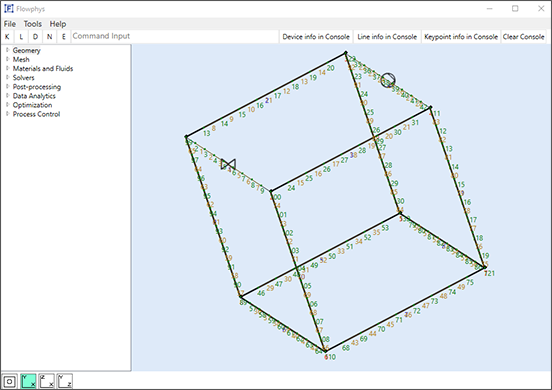
Geometry handling, meshing, solvers and post-processing in one environment, running on a workstation or on a project’s own servers.
Our main product is the software Flowphys, a finite element multi-physics simulation software for general geometries in 1D, 2D, and 3D geometries. Some of the features of the Flowphys software are:
An executable language for simulation — one a machine can write and our solvers run directly.
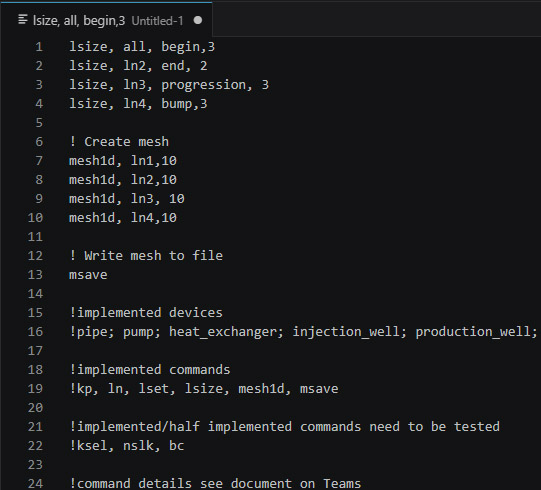
A FLUX script is a complete definition of a simulation: geometry, mesh, materials, boundary conditions, solvers, coupling and optimisation, in one readable file. Write it by hand, or let an agent generate it from a description and run it unattended.
An interface records what you clicked. A script records what the model is.
That decides whether a simulation can be checked, repeated or handed to someone else — and whether it can scale. Two thousand melt-pool configurations is a loop in a script and an impossibility in a dialogue box.
When an AI writes a simulation, the question isn't whether it runs. It's whether you can tell what it produced.
FLUX has a bounded grammar, so a script can be validated before a core-hour is spent — is the problem well posed, are the boundary conditions complete, is the mesh adequate. That check is what lets the agents refuse a bad request instead of returning a confident wrong answer.
And a FLUX script is short enough that someone will actually read it.
FLUX is optimised for modern tokenizers, and our tools curate training files from simulation output automatically.
Efficient tokenisation leaves more of a model's context for the engineering problem rather than the syntax, and makes training more sample-efficient. Most simulation languages were designed before anyone needed a model to write them.
Simulations produce output → our tools curate it into training files → the model writes FLUX → FLUX runs the solvers.
Describe a problem in words. The agents build the geometry, generate the mesh, apply boundary conditions, run and monitor the solve, train surrogates and optimise — iterating until the design meets the specification you gave.
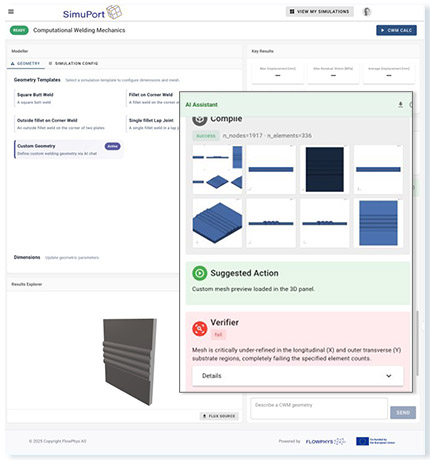
In the run shown here, the Verifier rejected a mesh as critically under-refined in the longitudinal and outer transverse substrate regions, and reported it rather than solving on it. Feasibility checks run before and after every FEM and CFD solve. A result that fails them does not get returned.
The agents write FLUX, the same language our solvers execute. Every model they produce is a complete, readable definition — open it, change one term, re-run it, hand it to a colleague and get the same result.
Geometry can come from conversation, from imported CAD, or from an image or sketch that our recognition turns into a 3D model or a pipe network.
Deployed on SimuPort today.
The physics engines beneath all of the above. Every solver listed here is deployed and running on SimuPort today, covering fluids, structures, thermo-mechanics, materials, electromagnetics and 1D networks. The same solvers power the desktop suite, SimuPort and partner integrations. More solvers are in development and move to production as they are validated.
Fluids
Jet and impinging flows · Heat transfer · Particle tracking · Pipe and channel networks
Manufacturing
Computational welding mechanics · Melt pools · Metal forming
Structures
Structural dynamics · Topology optimisation
Materials and chemistry
Thermodynamics · Chemistry
Electromagnetics
Photonics
Build on SimuPort. Bring your own solver, model or post-processing into the platform, and reach everyone using it.
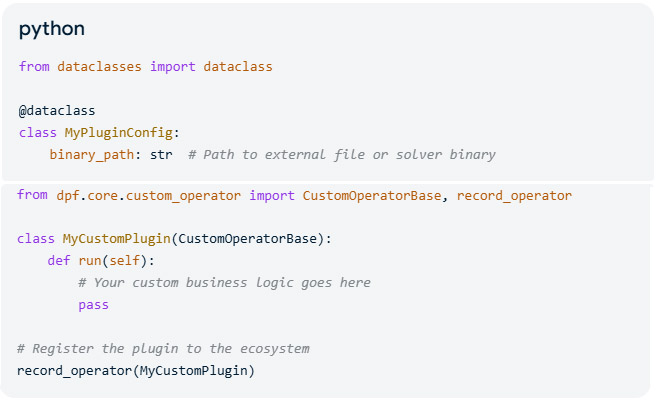
SimuPort is a platform, not a closed product. Partners can extend it with their own solvers, material models, post-processing routines and analysis tools — running on our infrastructure, alongside our physics, callable from FLUX and from the agents.
Flowphys operates its own high-performance servers for simulation, surrogate training and hosting SimuPort.
Browser access through SimuPort. Public simulators need no installation and no licence request.
The full suite on local workstations or a project's own servers, keeping data inside the organisation.
Operation on isolated infrastructure for consortia handling sensitive industrial data or with data sovereignty requirements.