What we develop
What we develop
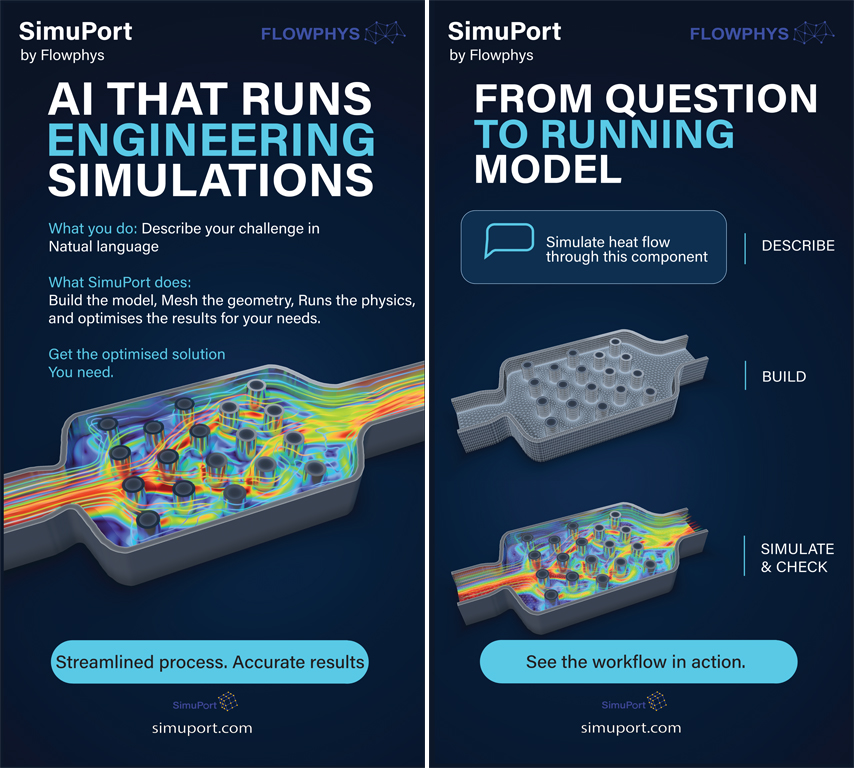
Every algorithm in the Flowphys suite is written in-house, without external numerical libraries. That gives us visibility into and control over every layer of the stack — solvers, coupling schemes, optimisation and surrogate training — and makes possible physics couplings and automation that are difficult to achieve when integrating third-party components. In a research project it means new physics can be added where a work package needs it, rather than approximated within the limits of an existing tool.
01
Solvers and numerical methods
The foundations, all developed and maintained by us.
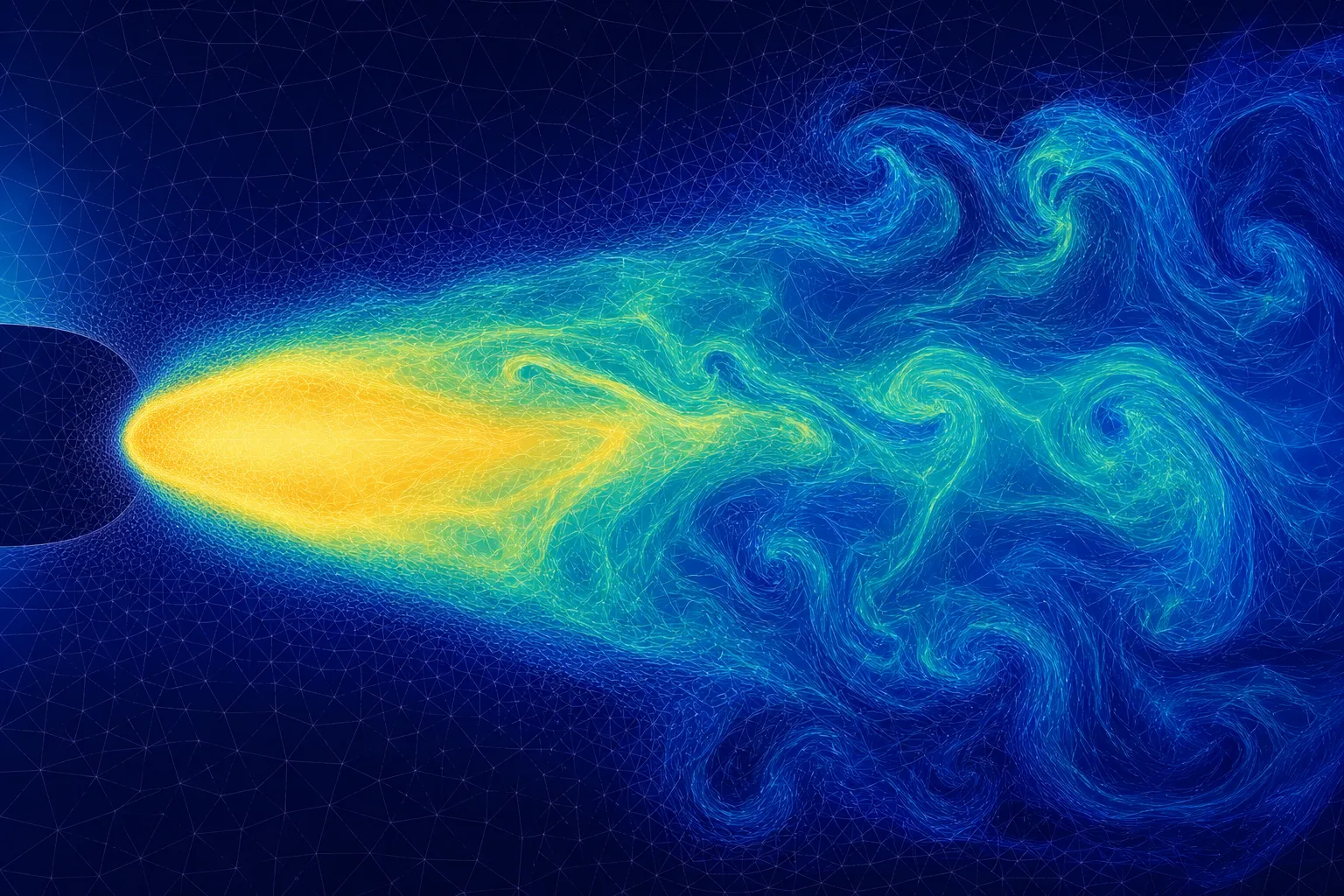
- Fractional-step finite-element algorithms for incompressible and weakly compressible flow
- Optimised large eddy simulation for turbulent flow
- Arbitrary Lagrangian-Eulerian methods with novel mesh-rezoning algorithms
- Geometrically exact beam and shell elements formulated on Lie groups
- Nédélec edge-element electromagnetics
- Multi-phase-field solvers for microstructure evolution
02
Coupled multi-physics
Physics solved together rather than passed between tools.
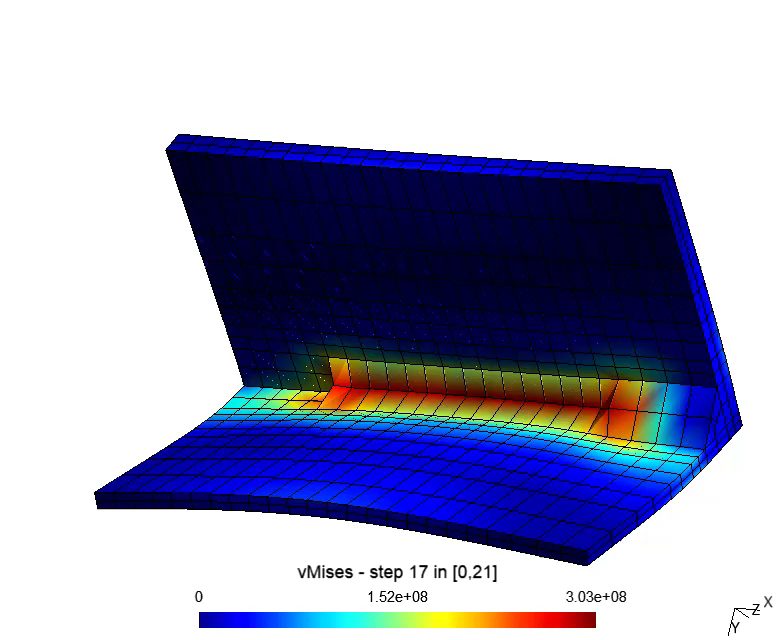
- Fluid-thermal, thermo-mechanical and fluid-thermal-mechanical interaction
- Fluid-acoustic interaction with variable-density waves in viscous turbulent flow
- Both staggered and monolithic thermo-mechanical formulations
- 1D network models coupled directly to 3D CFD
03
Optimisation and uncertainty quantification
A five-stage chain, run iteratively until the optimised designs stop changing.
- Latin hypercube design of experiments
- Hybrid Kriging, gradient-boosting and physics-informed surrogates
- Genetic-algorithm optimisation returning Pareto fronts
- Topology optimisation for structures, fluids and electromagnetics
- Fatigue constraints and techno-economic models inside the loop
04
Scientific AI
Models that learn from simulation and feed back into it.
- Physics-informed neural networks as fast, physics-respecting surrogates
- Operator learning — DeepONet and Fourier neural operators
- Proper-orthogonal-decomposition reduced-order models
- A family of scientific foundation models
Within projects we build to requirement: solvers for physics with no existing implementation, integration of models contributed by other partners, and interfaces into a consortium’s existing tool chain. Most of the capability above was first developed inside a funded project.