Flowphys keynotes SimuLingua at MSSM 2026. Per Kjellgren presented the Horizon Europe materials foundation model to the materials science community in Athens, 2–4 September.
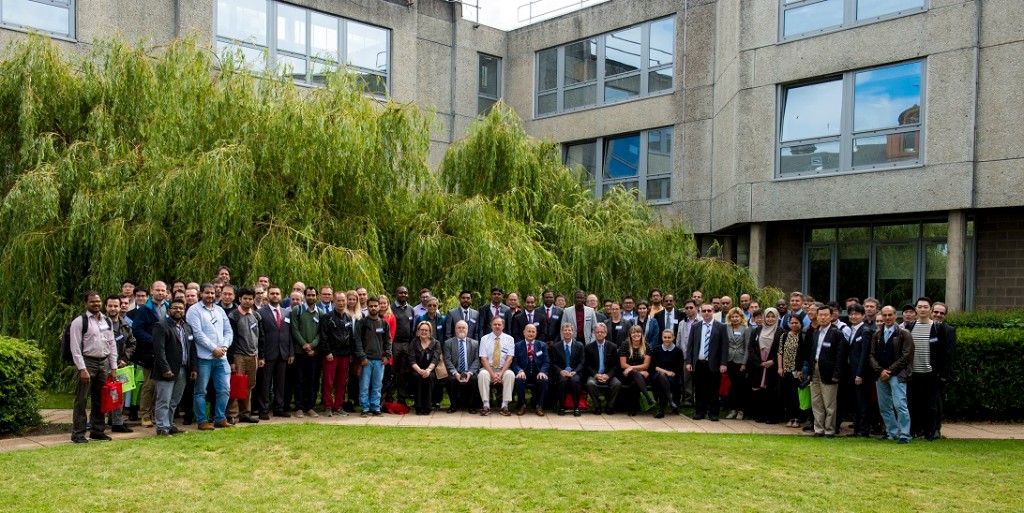
Keynote introduces Horizon Europe materials foundation model to the materials science community
Athens, 3 September 2026 — Flowphys presented SimuLingua this week at the 12th International Conference on Materials Science & Smart Materials (MSSM 2026), held 2–4 September at the National and Kapodistrian University of Athens.
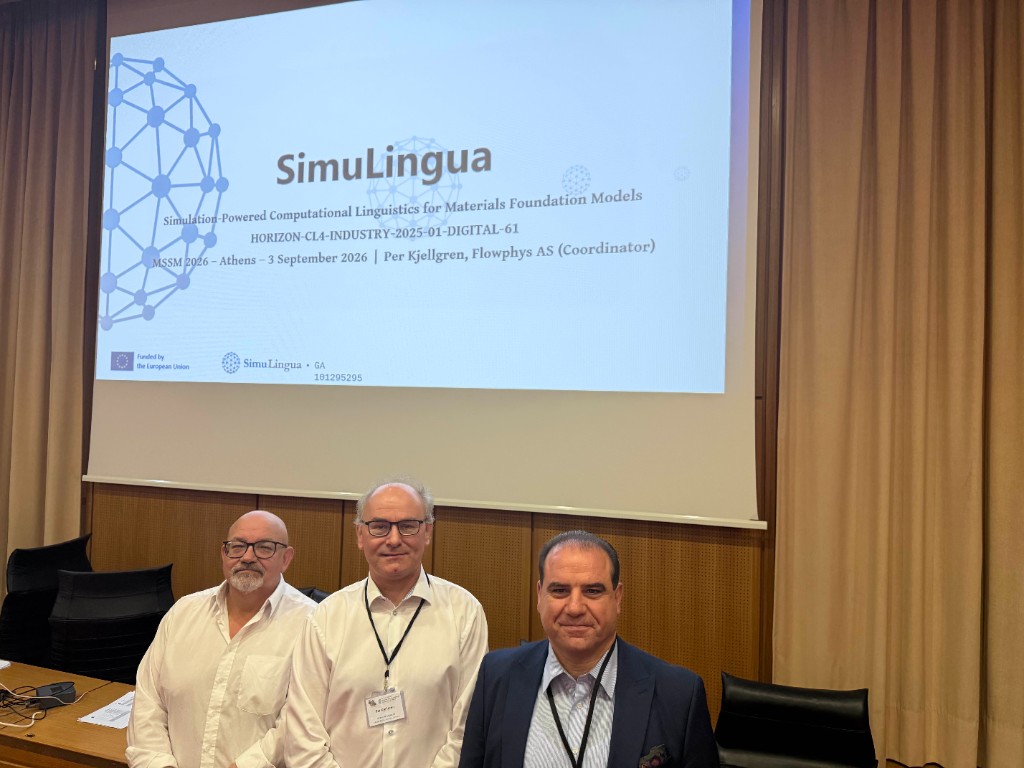
Per Kjellgren, Founder and Technical Director of Flowphys and coordinator of the Horizon Europe project, gave a keynote on Day 2 titled “SimuLingua: An AI Foundation Model for Materials Science”. The audience was the one SimuLingua is built for: researchers and practitioners working on characterisation, design, manufacturing and application of materials.
The SimuLingua project started on 1 June 2026 and runs 48 months, to May 2030. MSSM is one of the first major materials meetings after kick-off.
What SimuLingua is
SimuLingua — full title Simulation-Powered Computational Linguistics for Materials Foundation Models — is a Horizon Europe Research and Innovation Action under GenAI4EU (HORIZON-CL4-INDUSTRY-2025-01-DIGITAL-61; GA101295295). Flowphys AS coordinates a nine-partner consortium from Norway, Sweden, the United Kingdom, the Netherlands, Ireland, Lithuania and Ukraine.
The starting point is industrial, not rhetorical. Advanced materials still take years of trial-and-error to reach the market. DFT and other solvers exist, but they are expensive to run at screening scale, and the resulting data sits in incompatible formats. Most current materials AI is narrower still: one modality, one task, little coupling to physics.
SimuLingua’s answer is a generative model trained as a computational linguist for materials science. It is built to read and write the dialects of the field at once: chemical formulas, simulation numbers, microstructure images, crystal graphs, and the language of the literature. Those sources are fused in one Scientific Foundation Model (SciFM), not stitched together after the fact.
A SciFM is not a general language model with materials papers in the training mix. It is pre-trained on structured simulation and experimental data as well as text; it carries physics priors in the architecture and the loss; and its outputs are checked by solvers. The four capabilities the consortium uses as the test are domain adaptation, domain generalisation, problem adaptation and problem generalisation — fine-tuning on a new class with little data, zero-shot work on an unseen chemical space, transfer across related tasks, and extension into a new physics regime without a full retrain.
The model is only half of the system. It is coupled to a physics-in-the-loop generative engine and an AI-accelerated multi-scale pipeline: DFT → CALPHAD / phase-field → CFD / FEM. The intended loop is closed. The model proposes candidates; surrogates and reduced-order models test plausibility and performance; validated results return through a FAIR knowledge graph. Domain experts query that graph, launch virtual experiments and steer multi-objective inverse design in natural language.
That is the same argument Flowphys makes on SimuPort. A general language model has read about physics; it has not run any. Simulation can generate correctly labelled data on demand, and every claim can be checked against a solver.
Flowphys’s role
Flowphys is coordinator and a core technology developer. The company contributes:
- project management and the open scientific foundation model
- phase-field, CFD and thermo-mechanical stages of the multi-scale chain
- PINN and operator-learning surrogates, and POD-based reduced-order models
- multi-objective Pareto optimisation
- uncertainty quantification
- APIs to the model and the solvers, and the online platform that will host demonstrators
Why the conference matters
MSSM is a compact, application-facing materials meeting. Presenting SimuLingua there, rather than only in an AI or digital-industry forum, is deliberate. The people who will eventually query the model in natural language, reject an unsynthesisable proposal, or rerun a melt-pool or cladding case on SimuPort sit in that room.
Flowphys will continue to publish approved research results as runnable demonstrators.
Links: SimuLingua on Flowphys, simulingua.eu, MSSM conference programme.